
Rates
Let’s have a conversation about rising interest rates in the bond market.
But before we do… I know there is a portion of you whose eyes glaze over when the words “interest rates” “bonds” and “yield curve” enter the conversation.
You know how I know this? Because I have a wife. And I’ve seen the effect these words have on her face. It’s involuntary. Her heart is telling her to “lock in” for her husband… but her face, her sweet face does not lie.
I’m also aware that there is a small, nerdy subsection of people who really enjoy this stuff. You belong in this group if you watched Kevin Warsh’s last press conference, or if you find the concept of duration interesting. You are my people.
This will be a choose your own adventure, written for two distinct audiences.
The generalists and the nerds.
I only have two sections before the glazing eyes start for my generalists. Let’s light this candle.
Generalists:
That Federal Reserve thing you keep hearing about? That is the central bank of the United States.
Congress has given it two jobs:
Keep employment strong.
Keep prices stable.
The Fed balances both of these goals through monetary policy. Its primary tool is influencing short-term interest rates.
At its simplest, interest is the price of time.
You lend me $100 and I promise to pay it back to you one year from now with interest. Interest is what you earn for waiting.
Different lengths of time pay different rates of interest. Lending someone money for three months is not the same as lending someone money for 30 years.
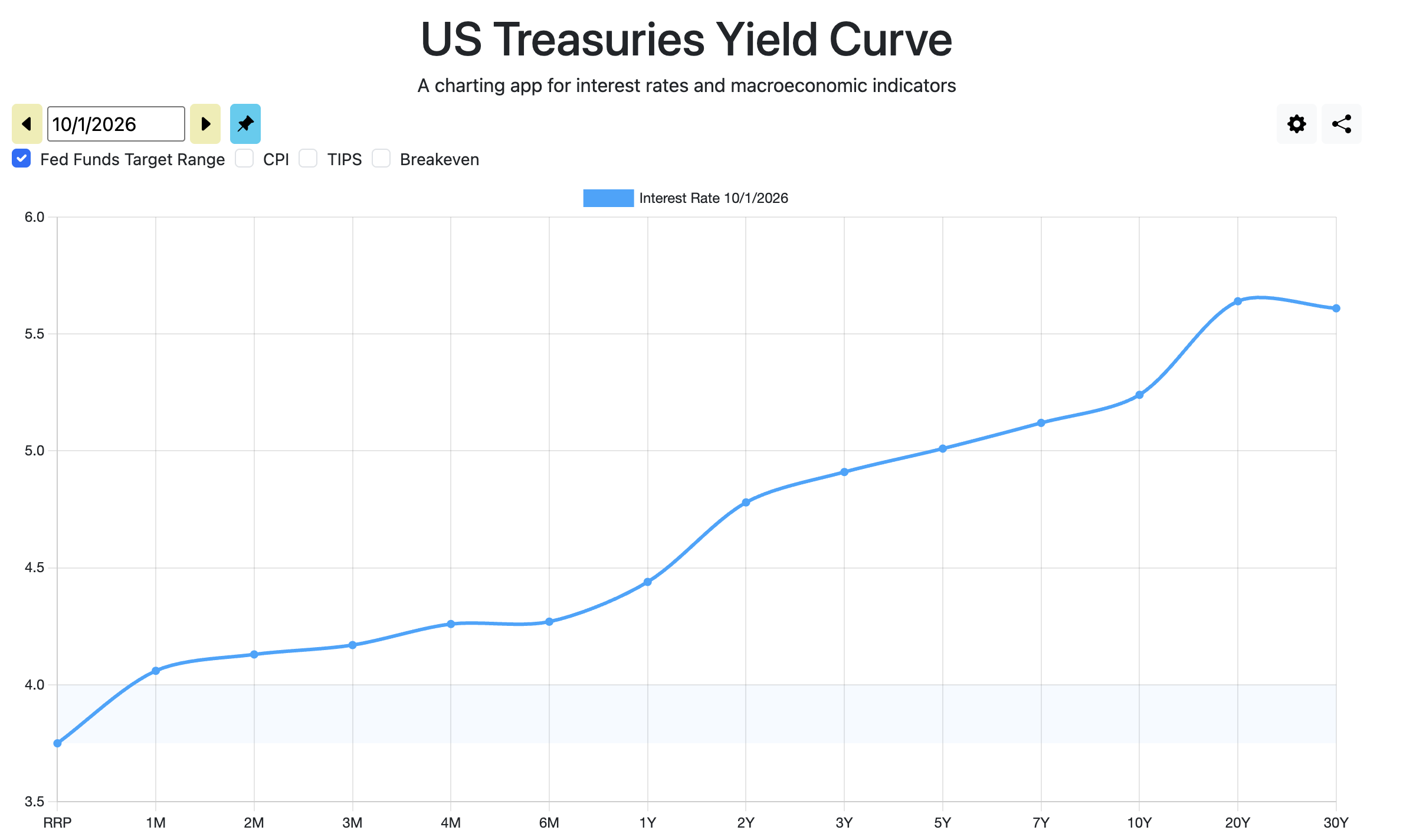
A yield curve is a visual representation of the different rates of interest paid at the corresponding lengths of time.
Here is an example of the US treasury yield curve.
The blue line is what the US government is currently paying in interest to borrow your money for each given time frame.
The Federal Reserve sets the first dot. The market sorts out all the other dots.
Oh no, I can see the glaze starting to form. One more concept. Quickly!
The US Treasury market is the starting line for every other investment on this planet. It establishes the return you can earn with the least amount of default risk.
Every other financial asset is priced relative to this benchmark. After all, why would you invest in something with more risk if it doesn’t offer the potential for a higher return than the safest bet in the world? You wouldn’t — and neither would the market.
I love this description from Josh Brown’s Blog on the importance of the US Treasury market.
“The US Treasury bond is like the sun. Every other asset class is like a planet orbiting that sun, deriving light and heat from it and maintaining its own place in the firmament accordingly. Every risk is priced relative to the risk-free rate of return emanating from what one could earn simply parking money in a Treasury instrument - be it a bill, a bond or a note….
The Treasury is the center of the galaxy. The price and relative attractiveness of anything you could put money into stocks, real estate, corporate or municipal debt, venture capital, private equity, Bitcoin, gold, collectibles, etc keys off of what one could earn by taking no default risk at all via holding cash in US dollars or Treasury bonds.”
When the center of the financial universe (Treasuries) starts paying more, it trickles into everything, and everything is competing for your money. Treasuries compete with gold, gold competes with stocks, stocks compete with real estate, real estate competes with crypto, and on and on. We're constantly evaluating where your resources are concentrated and which investments are competing for your dollars most impressively.
I know that look well. My time is up with the generalists.
Let me leave you with three practical things.
Get paid on your cash. Cash should be earning around 3.5%. If you are earning less than that, it may be time to reevaluate where you are holding your cash.
Borrowing is more expensive. The math continues to worsen for using any sort of debt to fund your life. This hits especially hard for those trying to buy a home right now.
*If you, or someone close to you, needs help running the numbers on renting vs buying a home, we’d be happy to help.Get someone on your team who is evaluating the tradeoffs in your portfolio. If you are interested in what this means, come on down to the nerd section with me.
Nerds:
Let’s start with some bond fundamentals.
We know a bond’s yield and price are inverted. If yields go up, existing bond prices go down.
Which makes sense right? Who wants to buy your existing 10y bond paying 4% when they can buy a new 10y bond paying 5%? The only way to sell your bond is to discount the price of it.
Your cheatsheet: Yields up = price down. Yields down = price up.
A bond’s duration measures how sensitive its price is to interest rates. Bonds with longer maturities and lower yields have higher duration.
A bond with a duration of 5 would be expected to move +/- 5% in price for a 1% change in interest rates.
Side Note: Nerd’s, I’ll let you in on a little secret. Nothing impresses people less than calculating a bonds duration by hand. And I know you’re thinking that can’t be right, because I was thinking that too, but I’ve attempted this exercise several times and the generalist in my life confirmed… not impressed.
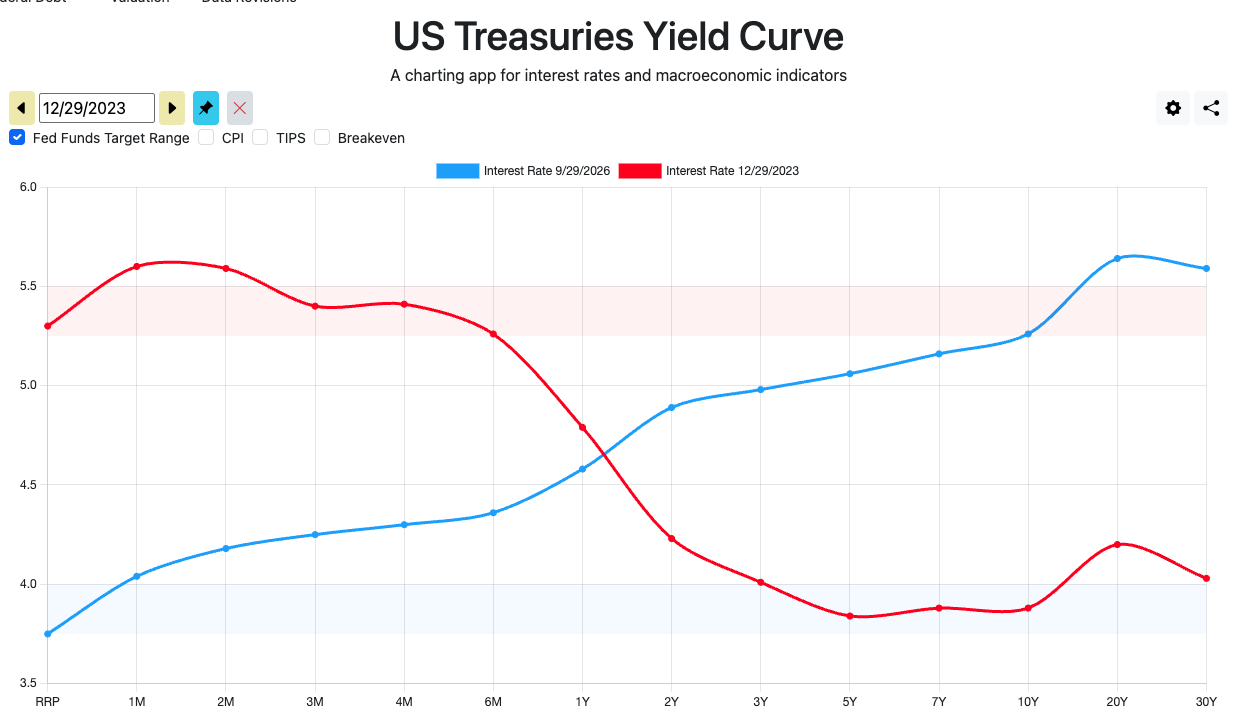
Two paths to arrive at current yields. different outcomes.
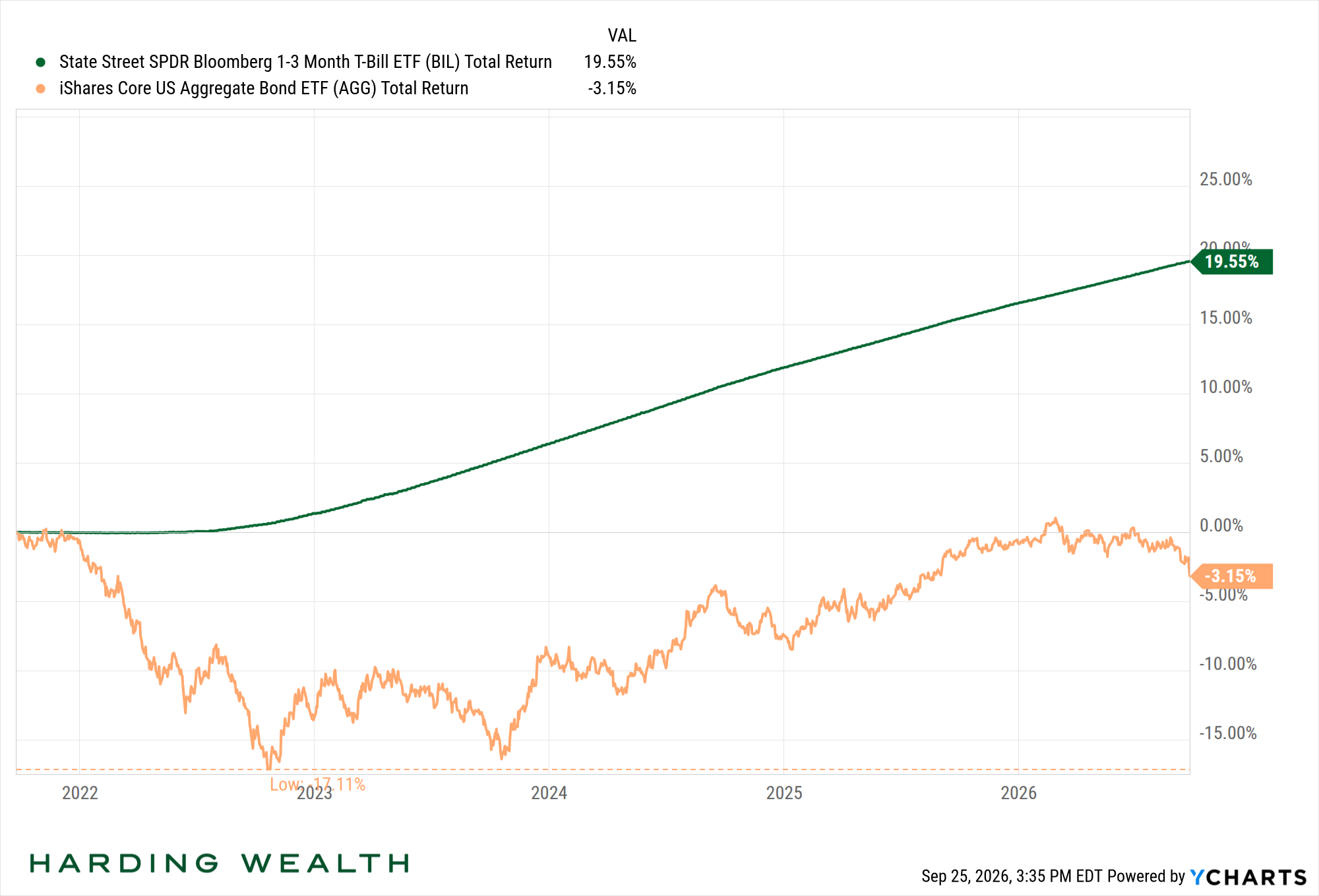
Investors In Good Shape: If you spent the last several years using ultra short bond funds, money market funds, and other short-duration investments for your cash and bond allocation, you are in good shape. You’ve collected your yield while experiencing very little to no price decline (green line). You have arrived at todays higher yielding opportunities with money in your wallet.
Investors In Rough Shape: If you spent the last several years holding a diversified, longer duration bond index, like the AGG (orange line), you haven’t had it as good. As yields increased the price of your existing bonds fell. Your total return over the last five-ish years is negative, and remember total return assumes the income along the way was reinvested. Oof. You have arrived at todays higher yielding opportunities with a few bruises and less money in your wallet.
Rising Rates: Time to sell stocks and buy bonds?
The math and future opportunity set for bonds looks substantially better now than it has in a very long time. The real return on TIPS (treasury inflation protected bonds) hasn’t been this high since 2001.
Is now the time to sell stocks and load up on bonds? Probably not.
Is now the time to allocate some of your ultra-short cash into short duration bonds? Maybe.
The truth is no one knows where yields are going from here.
There are no free lunches in markets. Bond yields are higher for a reason and may continue to blast higher from here.
The US is in a quagmire in Iran. Global trade and alliances are being rewritten. Inflation has been the resounding policy choice. Fiscal deficits are widening. Demographics are worsening. There is real fear that the supply of corporate bond issuance from the hyperscalers to build out the AI capex boom is adding supply strain on increasingly tapped out US treasury buyers.
If bond yields do blast higher, you will be glad you remained on the short end of the curve with less duration.
If bond yields stabilize or fall due to a peace resolution, or some sort of worsening economic situation, you will want more duration.
There have been many interest rate cycles in US history. All with their own unique set of circumstances.
To navigate this one I think it is helpful to think about why we own bonds in our portfolio in the first place.
1) As a reserve for our cash. Earning interest on money we know we will spend in the short term (0-2years).
2) As a way to provide precision in outcomes for income or spending in the medium term (0-10years).
3) For asset allocation. In an effort to buy assets that may have a different return correlation to stocks.
Historically, though not always, high quality bonds, specifically US treasuries with duration, have provided protection during stock market shocks. For some, this dampener effect can help them stay invested.
Portfolio Tradeoffs To Examine
Everyone should own stocks for the same reason— future growth. And the data is clear on which stocks we should own, which is mostly a slice of every single stock there is. The most difficult question for investing in stocks isn’t what to own. It is how much to own.
I might own 100% stocks. Because I’m young(ish), and I have 25 more working years to earn income (which is like owning a long bond).
You might own 50% stocks and 50% bonds. Because you are not as young as you once were, and have no more years to earn income.
Bond investing is different. We have more known information about the future expected returns of bonds than we do with stocks. There are still unexpected things that can happen to our bonds (inflation, interest rate risk, credit defaults, etc.) but knowing the starting yield of a bond offers a level of precision we don’t get with equities. Because of this, your bond portfolio should be built custom to your life and desired outcomes. The amount and type of bonds that’s best for you might not be the same amount and type of bonds that’s best for me.
There are tradeoffs all the way down with bonds. How much additional yield is worth taking additional risk? Our goal isn’t to predict where interest rates go or when the next credit cycle happens. It’s to build a portfolio that stands up to everything that will be thrown at it over the next 20 to 30 years.
David Young | CFP® | Interest Rate Nerd
Advice and Strategy - Harding Wealth
