
Past Dwellers

During a recent call with a client, he asked me a question:
“Adam, why can’t we just sell the funds that aren’t doing as well and buy the ones that have gone up the most over the last five years?”
It’s a reasonable request and a sentiment you may have had at one time or another.
And plenty of reasonable people use past performance as a guide for making investment decisions. Over the years I’ve connected with hundreds of Dave Ramsey disciples who want to honor his method of choosing funds — a method that explicitly suggests using recent 5 year or 10 year performance as a basis for choosing a fund.
Why wouldn’t we do this? After all, in most areas of life, past success is a good guide:
We make dinner reservations at the spot with good recent reviews and we hire the contractor with the great track record. So why not do the same with investments?
The data tells the story.
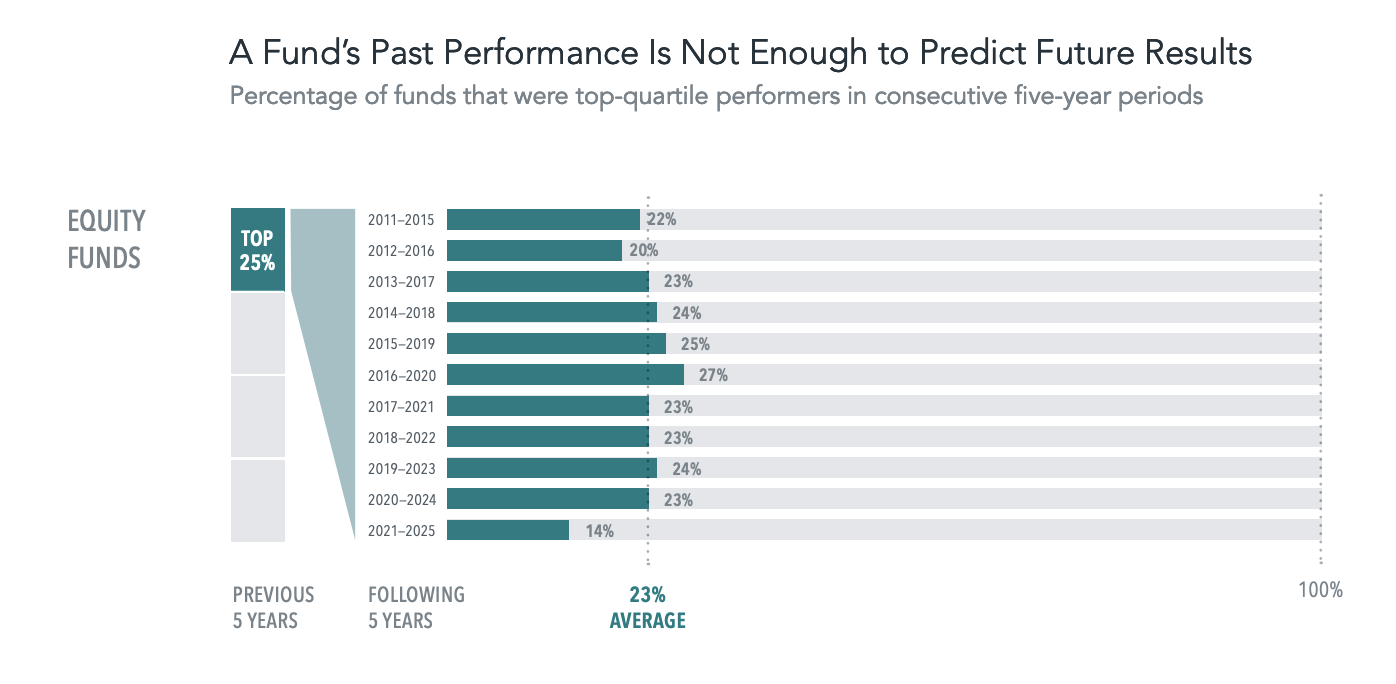
Dimensional Fund Advisors looked at equity mutual funds that ranked in the top 25% of their peers over a five-year period, then checked how many of those same funds stayed in the top 25% over the next five years.
On average, only about 23% did.
That figure matters because if fund performance were purely random, you’d expect about 25% of any group of funds to land in the top quarter by chance alone. Instead, a strong five-year record gave almost no edge in predicting the next five years.
And in the most recent period studied (2021–2025), only 14% of prior top performers repeated, which is noticeably worse than a chance happening based solely on probability.
Why does this happen?
Strong recent returns often come from a fund’s particular style or sector being in favor at the right time, and those cycles rotate. A fund that has risen sharply has frequently done so because its holdings became more expensive, which can leave less room for future gains.
Buying after a big run-up often means paying a high price for what has already happened, rather than for what’s likely to happen next.
You know this when you’re looking at an individual stock, thinking to yourself “why would I buy this after the big rally?”
The hidden costs of switching
Even setting the odds aside, constantly rotating into recent winners has real costs. Selling in a taxable account can trigger capital gains taxes, and every trade can add transaction costs. Most importantly, the pattern of selling what’s lagged and buying what’s surged is, in practice, a disciplined way to sell low and buy high, which is exactly the opposite of what we want.
It’s important to hold things you think you’ll want to own in almost any season — things you won’t frequently want to switch in and out of.
So…. What should we do?
A fund that’s underperforming isn’t automatically a problem, and a fund that’s soared isn’t automatically a solution. What matters is whether each holding still serves its purpose in your overall strategy.
There are good reasons to own underperforming funds — in much the same way that it’s a good idea to pay car insurance premiums even if you don’t get in a wreck. Sometimes you own things which will be helpful in a different kind of market environment — and that’s okay, you know how things can shift quickly.
But if you own a stock fund based on exceptional recent performance and expect that performance to continue, you may want to rethink your strategy.
As always, if you have questions about anything in your portfolio, I’m happy to talk them through.
Adam Harding
Cell: 480-205-1743
Mutual Fund Data Source: Dimensional Fund Advisors. Past performance is no guarantee of future results.