
Editor's note: I first wrote this post in October 2021, after a fairly modest 5% pullback. Today the market handed us something a lot bigger. The lesson hasn't changed, so I'm bringing it back with an update.
What happened today
On Thursday, November 5, the S&P 500 fell about 4.4%, the Nasdaq dropped about 5.5%, and the Dow lost more than 1,800 points. Every sector in the S&P 500 finished in the red, chip stocks had one of the worst days in their history, and the Nasdaq is now officially in correction territory (down 10% or more from its high). It was the worst single day for the major indexes since the tariff shock of April 2025.
The short version of the "why": after this week's midterm results, investors rushed to rethink how fast the AI data-center buildout will keep going, and the stocks that had run the furthest fell the hardest.
That's what happened. What happens tomorrow, next week, or next month, nobody knows, and I won't pretend to. But I do know something about how to get through days like this one.
My first crush
I had my first crush when I was in 5th grade at Riverside Elementary in Boise, Idaho.
After weeks of waffling over what to do with my feelings, I finally expressed them in a Valentine's Day card. Unfortunately, they were not reciprocated.
I was as devastated as a 5th grader could be. It was the end of the world at the time but, miraculously, I got over it.
I'm sure failed romances were pretty common for me growing up, but I can't really remember any of them except that first one. And even that one didn't turn out to be the monumental thing I thought it was at the time.
As you might guess, this blog isn't about the romantic escapades of a young financial advisor prodigy. (I was no prodigy. I was into Ninja Turtles and basketball, not asset allocation and tax rate arbitrage.)
This blog is about working through first experiences.
Your first one
For some of our newer clients, and maybe for some of you reading this, today is your first real gut-punch day as an investor. The stakes are much higher than my 5th grade Valentine, but the pattern tends to be the same: the bad days rarely look as bad in hindsight, especially when they leave us with experience we can use next time.
Experiencing past market crashes, and their subsequent rebounds, is what helps us build the behavioral fortitude necessary for enduring the next one.
If you've been with us for a while, you have plenty to draw from: the 2022 bear market, the tariff shock in the spring of 2025, and the 2020 crash before that. Each one felt like the end of the world in the moment. Each one, looking back, is part of why we can sit a little stiller today.
If you're newer, days like this one are the experience. Let's not waste it. Making big changes in the middle of turbulence is usually how investors do more damage than the market ever could on its own.
A story we can get behind
If you've read this blog for a while, you know I'm a sucker for the data.
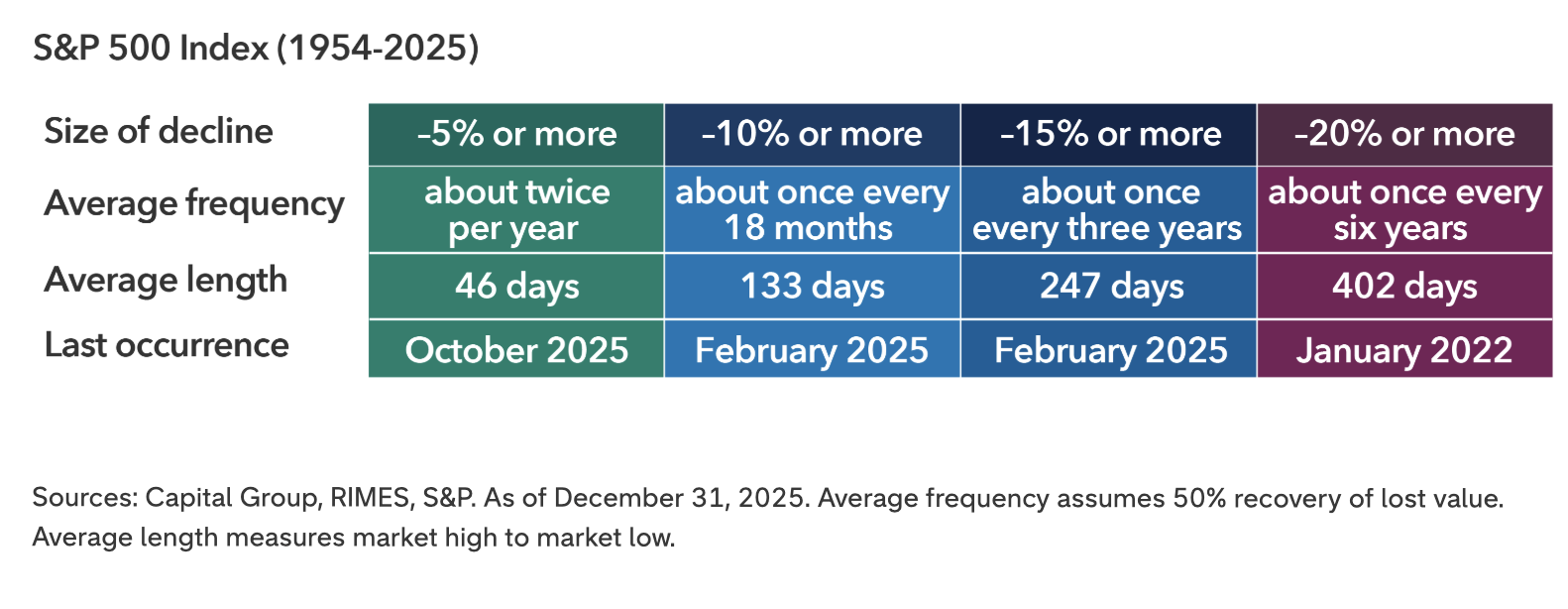
Declines are normal. Historically, the S&P 500 has seen a 5% pullback roughly two times a year on average, and a 10% correction about once a 18 months. It doesn't feel normal when it's happening, but it is the price of admission for the long-term returns stocks have delivered.
Buying at highs hasn't been the mistake people fear. Back in 2021, I shared data showing that investing in the S&P 500 at all-time highs has historically done slightly better than investing after a 20% drop. It's counterintuitive (you'd think buying the dip would win, right? Me too), which is exactly why the objective data matters more than our instincts. If you want to nerd out on this data with us, here’s a youtube video about it.
Price and value are not the same thing. We spend most of our time asking what an investment is actually worth, not what it did today. We all want things in life today and in the future — and we have to ask whether stuff the we own is good at pursuing those things. Does a single day or week or month change that outlook? Not unless the goals we’re investing for are short term.
And, look, the takeaway hasn't changed since 2021: if you have time on your side, it's almost always a good time to be invested, regardless of where prices sit today. But time alone isn't enough. We also need the discipline to stick with a plan when it's uncomfortable.
Discipline usually comes from experience. If you don't have the experience yet, you at least have the research, and that's where I can help.
Let's talk
If today has you doubting your strategy, that's completely understandable. Let's talk about it. Send me an email or book a call anytime.
In the meantime, stay optimistic. There's a whole industry that benefits from manufacturing fear (looking at you, news). We don't have to give them our attention.
Onward,
Adam Harding | Advisor | Owner @ Harding Wealth
Past performance is not indicative of future results. This post is for informational purposes only and is not a recommendation to buy or sell any security.