
I hate to be cliche and talk about the weather, but Arizona in late October is beautiful. The heat finally breaks, our seasonal residents start rolling back in, and the energy changes.
If you live here, you also know what comes with it. Mailers. Texts from numbers you don't recognize. The same three TV ads on loop during every football game. We're a swing state, so we get the full treatment.
And along with that, the questions can come in… "Adam, should we be doing anything before the election?"
It's a fair question. It's your money, and the stakes on the news feel enormous. So let me give you the honest answer, and then show you why I'm so comfortable giving it.
The honest answer: no. Not because of the election, anyway.
Here’s why:
You have to be right twice…
To trade your way around an election, you need two correct calls. First, who wins. Second, how the market reacts to that win. Most people only think about the first one.
Remember 2016? The polls mostly pointed the other way, and plenty of smart people wrote that stocks would tumble if Trump won. He won. The next day, the S&P 500 closed up about 1.1%. More recently, would you have expected foreign stocks to outperform US stocks when a Pro-American, Pro-Business president was elected in November 2024? Most would not, but that’s what’s happened.
So picture the investor who nailed the upset. They'd have gotten the hard part right and still lost money on the trade. That's the trap. Being right about politics and being right about markets are two different skills, and almost nobody has both on demand.
A hundred years of midterms…
Midterms feel smaller than presidential years, but the question is the same. Our friends at Dimensional Fund Advisors looked at every month of S&P 500 returns from 1926 through 2025 and flagged the months with a midterm election.
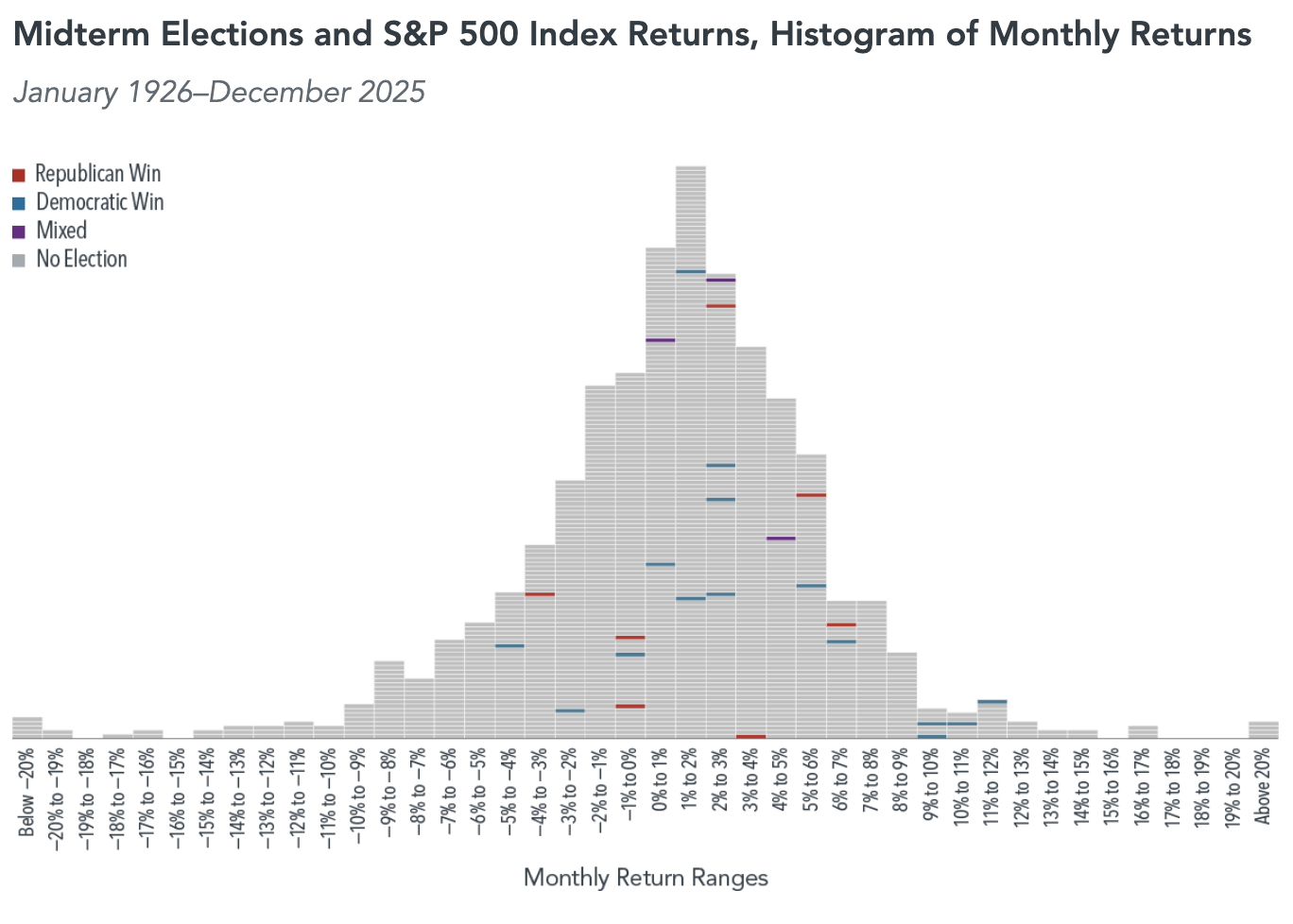
The result is almost boring. Election months landed right in the middle of the pack. Some good, some bad, most ordinary. It didn't matter whether Republicans took both chambers, Democrats did, or the two split the difference.
Zoom out further and it gets more interesting. Track a single dollar invested in 1926 through the end of 2025, and color each stretch by who ran Congress. You see big run-ups under every arrangement. You also see ugly drops under every arrangement. What you don't see is a pattern.
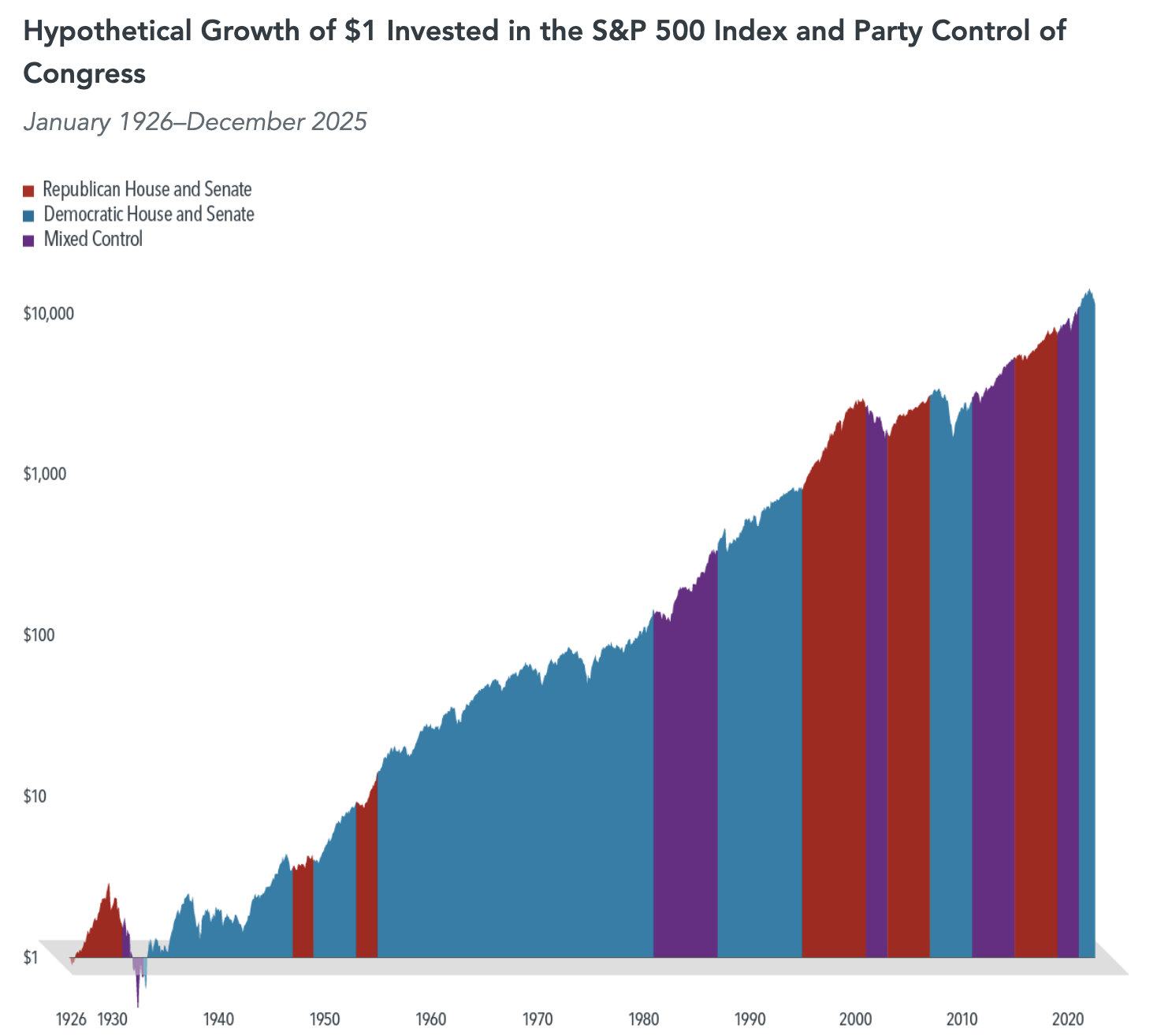
The line just keeps climbing, through red, blue and purple. Markets have rewarded patient owners no matter who held the gavel.
The market already read the polls…
Here's the part that matters most for how we invest. Every day, millions of buyers and sellers put real money behind their best guesses. Polls, forecasts, policy proposals, betting odds. All of it gets folded into prices almost instantly.
That's the core of how we think about fair value. Today's price is the market's best collective estimate of what a company is worth, election risk included… And YOU are the market and everyone you know and don’t know and all of their automated trading agents and algorithmic programmed trading is too.
By the time you hear a prediction on the evening news, it's already in the price.
So to win by trading on the election, you don't just need to know something. You need to know something the entire market doesn't. That's a very high bar, and it's why we'd rather own the market at fair prices than try to outguess it.
What we're actually doing this November
"Do nothing" isn't quite right either. November is a busy month around here. It just has nothing to do with the ballot.
Your plan was built around your life: your income needs, your taxes, your family, your timeline. None of that changes on election night. What we are working on right now:
Year-end tax planning. Roth conversions, gains and losses, and charitable gifts all have a December 31 deadline. That's a real deadline. The election isn't. That said, the election results can give us a picture of what may happen to the tax code in years to come. A higher potential tax climate in the future may give us cause to claim more income at today’s rates (via withdrawals or Roth conversions or dialing back pre-tax retirement account contributions).
Rebalancing. If markets move sharply in either direction, we may rebalance. That's discipline, not prediction.
Required distributions. If you're taking RMDs, we're making sure this year's are handled on time and handling charitable intent along the way (QCDs).
If you want to talk through any of it, or if the headlines are keeping you up at night, call us. Or just hit this link and say, “let’s talk” That's what we're here for.
Vote, then change the channel…
Vote your conscience on November 3. Then do your portfolio a favor and tune out of the sensationalism. The yard signs will come down, the ads will stop, and your plan will still be doing exactly what it was built to do.
Onward.
Adam Harding
www.hardingwealth.com
Sources
Dimensional Fund Advisors, Midterm Elections—What Do They Mean for Markets?, October 2026. Charts used with attribution. S&P data © 2026 S&P Dow Jones Indices LLC, a division of S&P Global. All rights reserved.
Disclosures
Past performance is not a guarantee of future results. Indices are not available for direct investment, and their performance does not reflect the expenses of managing an actual portfolio. Investing involves risk, including possible loss of principal. This post is for educational purposes only and is not a recommendation to buy or sell any security. Harding Wealth is a registered investment advisor.